EDUCATION

Downloadable lecture/presentation notes

Introductory information for practical beekeeping from the Diploma in Apiculture

Below we plan to add various lecture notes from the Diploma that may be of use to Irish Beekeepers to help with apiary management.  We hope they will be of use. Most of them were developed by Dr Helen Mooney & Prof Grace McCormack along with beekeeper colleagues whom we have collaborated with like Eamon Magee, Brendan Murray, Paul O Brien who helped us very much in the first year of the programme especially and who continue to support and contribute their time and expertise, and are dedicated to developing and sharing educational material for all. More beekeepers will be added when we get around to sharing their material.

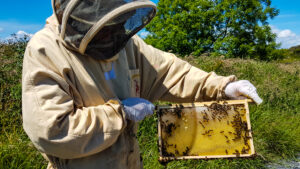
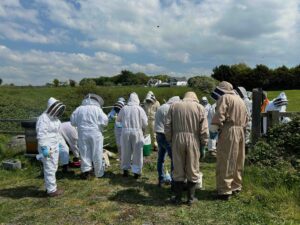
                                             Training Day at University Apiary 2024
1. Standard Operating Procedures for doing an inspection (Standard Operating Procedure#1-inspections (1))


Irish Bee Foundation Grade 1

These are handouts that contain a summary of the ideal content to be covered in a beginners course as identified by the IBF Education team (Brendan Murray, Daniel Hiney, Donal Cooper, Jim Agnew, Mairead Dineen Love, Michele O’Connor Connolly).  For further details, visit the Irish Bee Foundation website: https://irishbeefoundation.ie. Thanks to Paul O Brien, Chris Drury and Gus McCoy and to the education team for approving their sharing here.

Each file is a summary of the modules contained in the IBF Grade 1 syllabus

1. Summary of Module 1: essential equipment (Training Module 1 – Equipment)

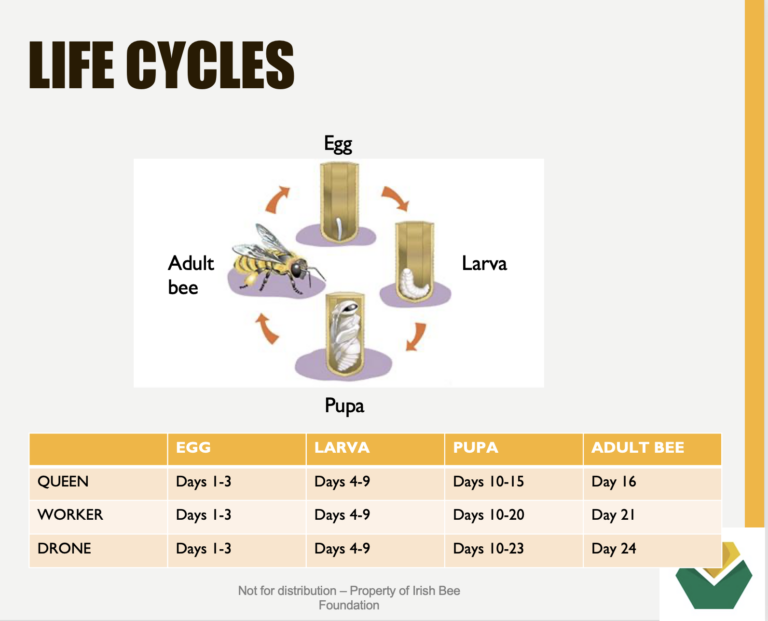
2. Summary of Module 2: The natural history of the honey bee. (Training Module 2 – Natural History of the Honeybee)

Information on various topics

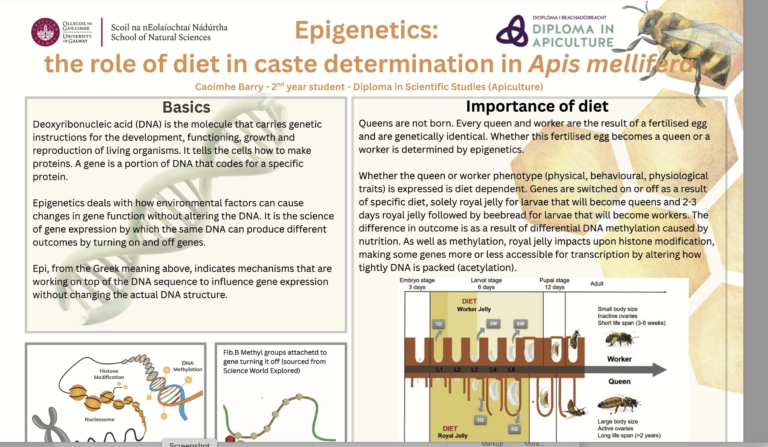
Here we will post presentation notes, slides, information on various topics that may be useful to Irish beekeepers. here I also include posters on various (mostly genetics) topics prepared by the students of the Diploma in Apiculture in 2025. They are excellent tibbets of information made by beekeepers for beekeepers. They were on display at the Native Irish Honey bee Society national conference in march 2026.

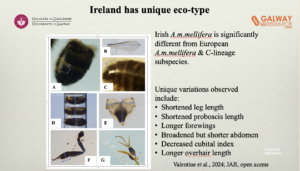
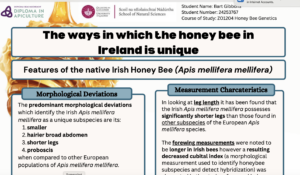
The ways in which the Irish bee is unique. A poster completed by Bart Gibbons who won a prize at the NIHBS conference for having the poster that best aligned with the mission of NIHBS (gibbonsbart_LATE_78219_3292974_Bee Poster)


CURRENTLY WE OFFER A TWO YEAR DIPLOMA IN APICULTURE

The main aim of this course is to provide quality third level education on bees and beekeeping. This course may be of interest primarily to beekeepers or those considering becoming a beekeeper. It will also be of interest to anyone who has an interest in entomology, pollinators, the decline of bees and pollinators more generally.

WE'VE GIVEN TALKS OVER THE YEARS!

Please watch and enjoy some of our content

Chiara Binetti SICAMM Searching for Wild Honeybees in Woodlands of Ireland

Despite the relatively low forest cover in Ireland, some ancient and long-established woodlands are still present and considered to be of high conservation value. This presentation illustrates the developed methodology for searching for free-living honeybee colonies in woodlands, including giving the details of its first applications in Ireland.

Alexandra Valentine 18th COLOSS Conference (2022 eEonference) Rapid Presentation

18th COLOSS Conference Rapid Presentation focusing on the introduction of SFI-funded PhD project titled “The evolution and adaptation of free-living Apis mellifera mellifera across the island of Ireland.

Alexandra Valentine | Characterisation of Irish free-living honeybee using DeepWings©

Morphometrics has been widely used in the study of honeybees since its development in the late 20th century. The original 26 subspecies of Western honeybees (Apis mellifera sp.) were characterised using a suite of 36 morphological characteristics by Fredrich Ruttner in 1988 and included the analysis of 11 angles of forewing venation and abdominal discolouration (banding) (Ruttner, 1988). However, with the development of molecular methods providing a more robust and accurate identification, morphometrics is often perceived as a redundant and outdated method. DeepWings is a free, open-source software developed in 2022 (Rodrigues et al., 2022) and has revolutionised the process of wing geometric morphometrics (WGM) to identify Western honeybee subspecies.

Stephen Smith | IPRN Talk Using Genomics to aid the Conservation of the Native Irish Honey Bee

Methods to detect hybridised honeybee colonies in Ireland using colony level pool-seq data.

Arrigo Moro | IPRN Talk Using Citizen Science to Scout and Monitor Wild Honeybee Colonies